
The Next Real Estate Cycle Has Arrived
By Rob Sigler, MBA
August 19, 2026
Real estate investment returns since the pandemic have been underwhelming to say the least. The Dow Jones U.S. Real Estate Index posted an anemic 2.2% annualized return over the past 5 years while the S&P 500 Index logged an invigorating 13.3% per annum. The culprit was not a single issue, but the confluence of many. As with most real estate investment cycles, low interest rates and easy financial conditions drove oversupply. In addition to these typical cyclical forces, we saw some major structural shifts over the past decade as well. Amazon obliterated the mall concept and hollowed out the tenant base of strip center retail. The pandemic ushered in a tectonic plate transformation in our work behavior, shifting on-premises workers to work-from-home and hybrid configurations. This single-handedly upended the demand for commercial office space. Finally, as the inflation cycle picked up in 2021-22, interest rates rose, and in fact, reside at 5-year highs today. Just like bond values, as interest rates rise, the value of real estate cash flows declines.
However, there is an interesting dynamic at play right now. This isn’t new. It has happened in virtually every other real estate cycle. The culprit of the unwind, namely rising interest rates, also is the source of the remedy. What does that mean? When rates were near zero, building and financing were easy. Returns on projects could afford to be low because the carrying cost of debt was also low. Fast forward to today. The 30-year Treasury bond has gone from 3.3% in 2023 to 5.3% today. That may not seem like a lot, but financing rates for projects are done at a considerable spread to Treasury yields to accommodate for increased risk. A project that may have been financed for 6.5% in 2023 is now approaching 10%. As a result, building permits and new construction have collapsed. The following chart illustrates that well. It shows you that supply growth in the major verticals of office, multifamily, industrial, and shopping centers is running significantly negative relative to 10-year averages and has been doing so for three consecutive years.
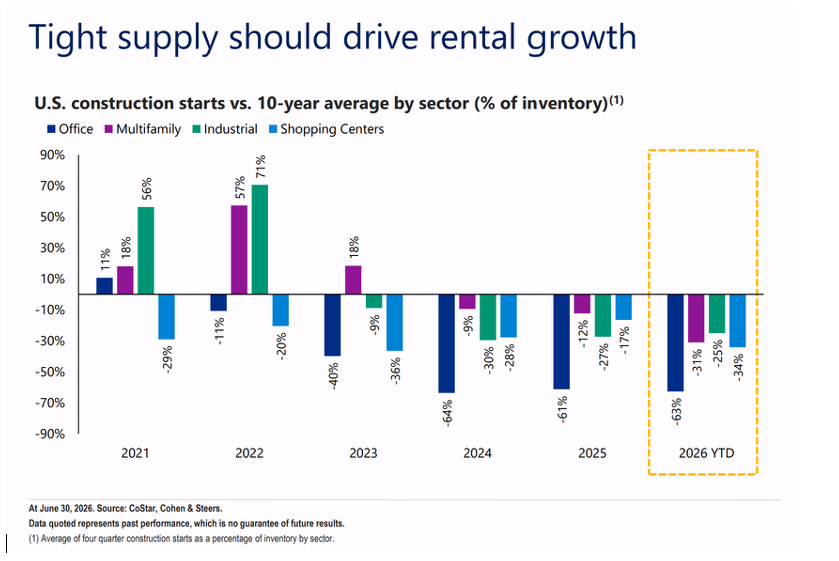
That sets the stage for recovery. When there is little building, we see increased absorption (meaning occupancy starts to improve as we absorb vacant space) and valuation stabilization. That is exactly what is happening today. Additionally, some problematic segments have remade themselves. Here are a couple of data points.
1. Malls have totally transformed themselves. They have replaced ailing department stores with sporting goods, home improvement, electronics, gyms, and other heavy goods items that are more Amazon resistant. They have turned their abundance of parking into drivers of traffic (restaurants and outdoor entertainment venues).
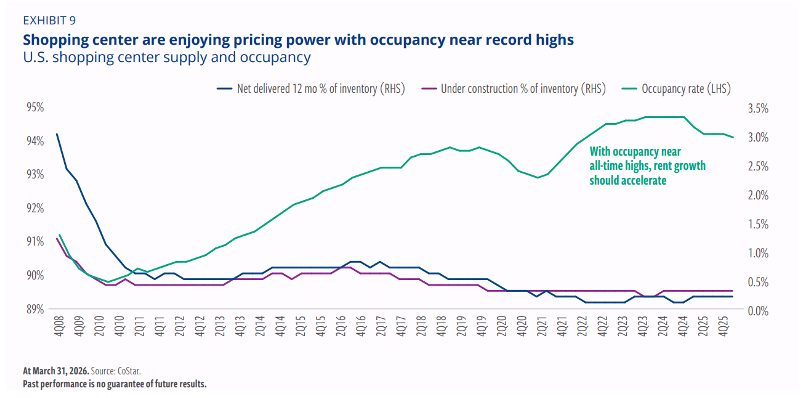
2. Strip centers have evolved as well. The bulk of eCommerce vulnerable related retail has been replaced with services (bank branches, dentist offices, hair and nail salons, specialty gyms for yoga or Pilates as well as quick service or fast casual dining). The most successful of these retail strips are grocery-anchored centers which assure steady shopper traffic. The improved health in this segment is easily illustrated. New construction is nearly zero while occupancy is exceptionally healthy. That should set the table for landlord pricing power in the future.
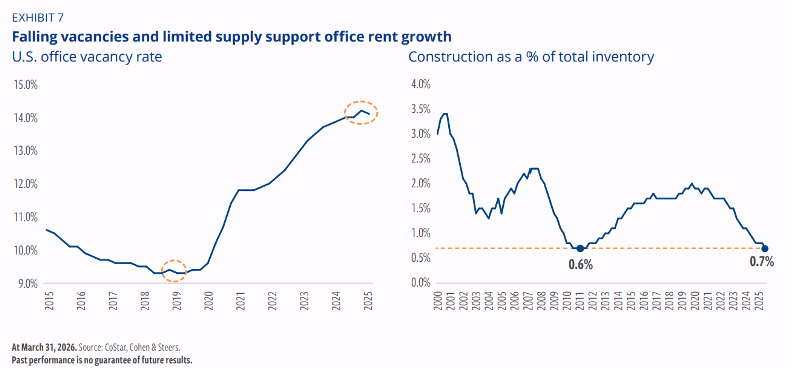
3. Commercial office remains challenging, however, there are positive developments. Namely, many buildings are being converted into other real estate applications. RentCafe estimates the office to apartment conversion pipeline reached 90,300 units nationwide in July 2026, four times the 2022 level. Bottom line, vacancies appear to be peaking while new construction is back to generational lows. Pricing, as a result, is stabilizing.
4. Multi-family is also staging a recovery. It’s not because demand is booming. It is healthy, but the real story is that absorption is up dramatically. What does that mean? Peak deliveries of apartments crested in 2024 with 588,000 units completed. That is significant considering that 340,000 new units are needed each year to balance demand growth. However, that building boom is now unwinding. Deliveries in 2025 fell to 340,200 and in the last quarter we saw only 77,000 units. As a result, we are starting to see occupancy lift once again. Rental rates are flattish across most of the popular Sunbelt areas that were the source of the greatest supply, however, they are inflecting up elsewhere in the country. The recovery is simply a matter of time.
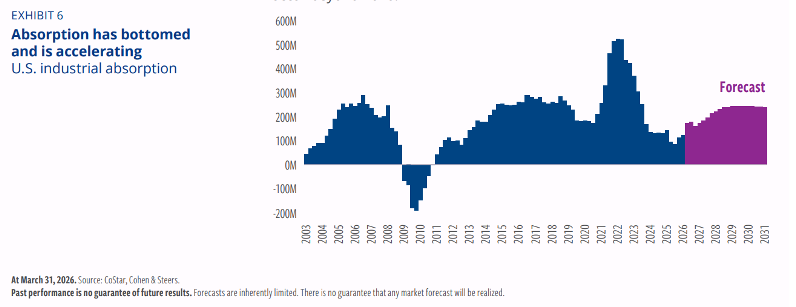
5. Unlike commercial office, industrial real estate boomed during the pandemic. With individuals working remotely and eschewing trips outside the house, e-commerce flourished. We saw a massive uptick in the need for logistic, warehousing, distribution, and fulfillment facilities. Absorption of idle space spiked quickly as vendors sought out these sites. However, the aftermath was a hangover as conditions started to normalize. Absorption crested in early 2023 and did not make its low until 2025. However, with trends normalizing, it appears we are setting the stage for recovery.
6. Finally, in the catch-all category of real estate there are some interesting standouts.
a. Single Family Housing. While the trickiest group to play presently given high mortgage rates and poor affordability, household formation (the creation of new family units that need housing) has outpaced single family housing construction nearly every year since 2008. It is estimated that we have a deficit of approximately 2mm homes in America. Amplifying this problem, housing stock is aging rapidly with the average home being 44 years old. Many of these are becoming either heavy remodeling candidates or outright rebuilds. This will pressure housing stock even further. While this real estate sub-sector will likely take longer to remedy itself given the pressures on new home buyers, for those willing to play the long game, it looks like an obvious bet. Curiously, Warren Buffett’s successor at Berkshire Hathaway acquired a single-family home builder as his first acquisition.
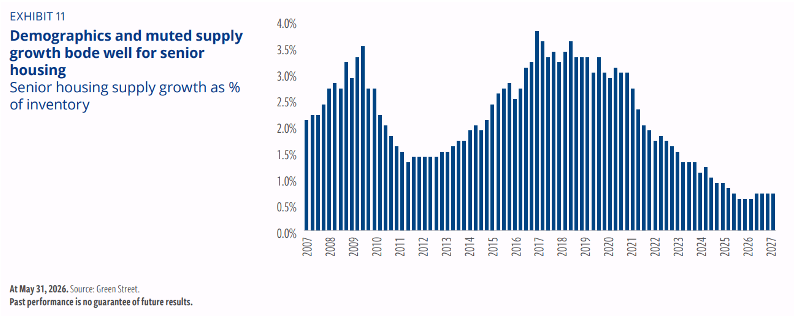
b. Senior Housing. The demographics don’t lie. 2026 represents the start of what has been termed the Silver Tsunami as the Baby Boom Generation of 1946 – 1964 starts to transition into their 80s. 76 million births were recorded over that period, setting the stage for aggressive growth in future demand. Despite this, senior housing supply growth has been falling steadily for the better part of the past decade.
Bottom line, we believe the supply/demand dynamics in the real estate industry portend a future recovery. Interestingly, despite those visible trends ahead, the publicly traded Real Estate Investment Trusts (REITs) sector trades at a significant discount to other public equities. Historically, when REITs are cheap, their annualized returns in future periods tend to outperform other equities.
About the Author

Robert Sigler, MBA
Rob serves as a Managing Director and the Chief Investment Officer for Westshore Wealth. Rob’s long career in the financial services industry reflects a diverse set of vocational tools and experience. He has advised some of the world’s most renowned […]
Learn More